Germany’s Permanent Residency Rules Have Changed. Here’s What Indians Actually Need to Know.
There is a version of this story that is being told incorrectly — on WhatsApp groups, on YouTube channels, and by agencies who package ambiguity into authority. The version goes something like this: Germany has shortened its PR timeline to three years. You can get permanent residency fast now.
That is not entirely wrong. But it is not the complete picture either — and the gap between what people are hearing and what the rules actually say is significant enough to cause real confusion for Indians already living and working in Germany.
The reforms introduced under Germany’s Fachkräfteeinwanderungsgesetz — the Skilled Immigration Act, which came into force in stages between November 2023 and June 2024 — did change several things about the path to permanent residency. But the timeline available to you depends heavily on your specific situation: how you entered Germany, what kind of residence permit you hold, your German language level, and whether you studied or trained inside Germany or abroad.
This article tries to untangle that clearly.
What Is Permanent Residency in Germany?
Permanent residency in Germany is formally called the Niederlassungserlaubnis — the settlement permit. It is not the same as German citizenship. Think of it as a long-term, secure status that allows you to live and work in Germany indefinitely, without the need to renew your residence permit every year or two. You can work as an employee or run your own business. Your family can be here with you.
There is a separate permit called the Daueraufenthalt-EU — the permanent EU residence permit — which is similar but carries additional rights across EU member states. For the purpose of this article, we will focus on the Niederlassungserlaubnis, which is what most working professionals in Germany are aiming for.
Both are quite distinct from naturalisation (citizenship), which has its own separate set of requirements.
What Changed Under the Skilled Immigration Act?
Before the 2023–2024 reforms, foreign-trained professionals — that is, those who completed their education outside Germany and arrived with a foreign degree — typically needed to wait four years before applying for a settlement permit. That threshold has now been reduced to three years.
This is the primary change that the “three-year PR” conversations are usually referring to. And it is a real improvement. According to Germany’s Federal Ministry of the Interior, more than 200,000 visas for gainful employment were issued in the first year after the Skilled Immigration Act came into force — a 10 per cent increase over the previous year. The reforms have clearly had an effect.
However, that three-year path is not automatic, and it is not available equally to everyone.
The Different Timelines — and Who They Apply To
Germany’s official government portal for skilled immigration currently outlines four main routes to a settlement permit, each with different timelines. Here is what they actually say:
Skilled worker with a foreign degree (standard path): 3 years
If you hold a foreign university degree or a recognised foreign vocational qualification, and you entered Germany on a skilled worker visa or similar, you can apply for a settlement permit after three years. You must have held a qualifying residence title throughout, paid into the statutory pension insurance for at least 36 months, hold a job covered by your residence permit, demonstrate German language proficiency at B1 level (B1 is a conversational, functional level — not fluency), pass a basic knowledge test about German society and law, and be financially self-sufficient.
The application fee is up to approximately €150 (around ₹16,800 at current rates of roughly ₹112 per euro).
EU Blue Card holders: 21 to 27 months
This is the most talked-about fast-track. The EU Blue Card is a residence permit for university graduates from outside the EU who earn above a minimum salary threshold. In 2026, that threshold is approximately €50,700 per year (about ₹56.8 lakh) for most occupations, and a lower €45,934 (approximately ₹51.4 lakh) for shortage occupations — which include IT specialists, engineers, physicians, and several other fields where India contributes a significant number of professionals.
EU Blue Card holders can apply for a settlement permit after just 27 months of qualified employment and pension insurance contributions. If they can demonstrate German language skills at B1 level, that timeline drops to 21 months — less than two years. This is the shortest available path to permanent residency for most working professionals, and it is genuinely significant.
Professionals who studied or trained in Germany: 2 years
If you completed your university degree or vocational training inside Germany — as many Indian students do — and have since taken up skilled employment, you can apply for a settlement permit after just two years of skilled employment. You still need to have paid pension contributions for 24 months, hold a qualifying job, demonstrate B1 German, and meet the financial self-sufficiency requirement.
This pathway matters more than it often gets credited for. According to DAAD (Germany’s Academic Exchange Service), India is now the largest source country for international students in Germany, with approximately 59,419 Indian students enrolled in German universities during the 2024/25 winter semester. Many of these students are moving into employment after graduation. For them, a two-year path to permanent residency is a concrete, achievable timeline.
Highly skilled workers: immediate
In certain special circumstances — senior scientists with demonstrable technical expertise, or teachers and researchers holding prominent positions with several years of professional experience — Germany’s law allows for a settlement permit to be issued immediately upon entry, without any waiting period. This applies to a small and specific group, and requires clear evidence of academic credentials and a strong assumption of financial self-sufficiency.
What Is Widely Misunderstood
The confusion largely comes from treating these timelines as interchangeable, or from assuming that the shortest timeline applies universally.
A few things worth clarifying:
The three-year path requires B1 German. This is not optional. B1 is roughly the level at which you can have a sustained conversation in German, discuss everyday topics, and manage workplace interactions in the language. Many Indians working in Germany — particularly in IT and engineering roles where English is the primary work language — have not prioritised German. The language requirement is a real gate, not a formality.
The Blue Card fast-track requires meeting the salary threshold from day one. You cannot enter on a lower salary and later qualify retroactively. The minimum salary must be met when the Blue Card is first issued, and the qualifying employment period counts from that point.
Permanent residency is not the same as citizenship. After obtaining a settlement permit (Niederlassungserlaubnis), the path to German citizenship — naturalization — has separate requirements, including a minimum legal residence period and language requirements. Germany’s 2024 citizenship reform reduced the general minimum residence for naturalization from eight years to five, with a three-year fast track for demonstrated integration achievements. These are different processes.
The 5-year figure you sometimes hear refers to the permanent EU residence permit (Daueraufenthalt-EU), not the German settlement permit. The EU permit requires five continuous years of legal residence in Germany, along with pension contributions of 60 months, financial self-sufficiency, adequate German knowledge, and sufficient housing. This permit is valuable for those planning to move between EU countries but is not the same as the German settlement permit.
Why This Matters Particularly for Indians in Germany
India’s presence in Germany has grown substantially over the past several years. The 59,000-plus Indian students currently enrolled in German universities represent a 20 per cent increase over the previous year, according to DAAD data. India has taken over from China as the largest source country for international students in Germany — a shift that reflects both the quality of German higher education and the deliberate effort by Germany to attract skilled workers.
Germany’s government has been transparent about the reason: it faces a severe skilled labour shortage. As noted in the Federal Ministry of Interior’s 2024 report, more than 1.34 million jobs were unfilled in the first quarter of 2024. The Skilled Immigration Act — and the shortened PR timelines that came with it — are partly a response to that need.
For Indians considering Germany as a long-term home, this creates a genuine opportunity. The path to permanent residency, while not simple, is now clearer and shorter than it was five years ago. For a Malayalee family in Kerala weighing whether a child’s Germany study plan is worth the investment — which often runs into ₹20–30 lakh or more for initial years — the existence of a clear, structured path toward stable long-term residence in Germany is a meaningful piece of the calculus.
The student who graduates from a German university and stays in employment for two years before receiving a settlement permit is in a very different position from the one who returns to a crowded job market at home, or from the one navigating a difficult immigration system in Canada or the UK.
A Few Practical Things to Know
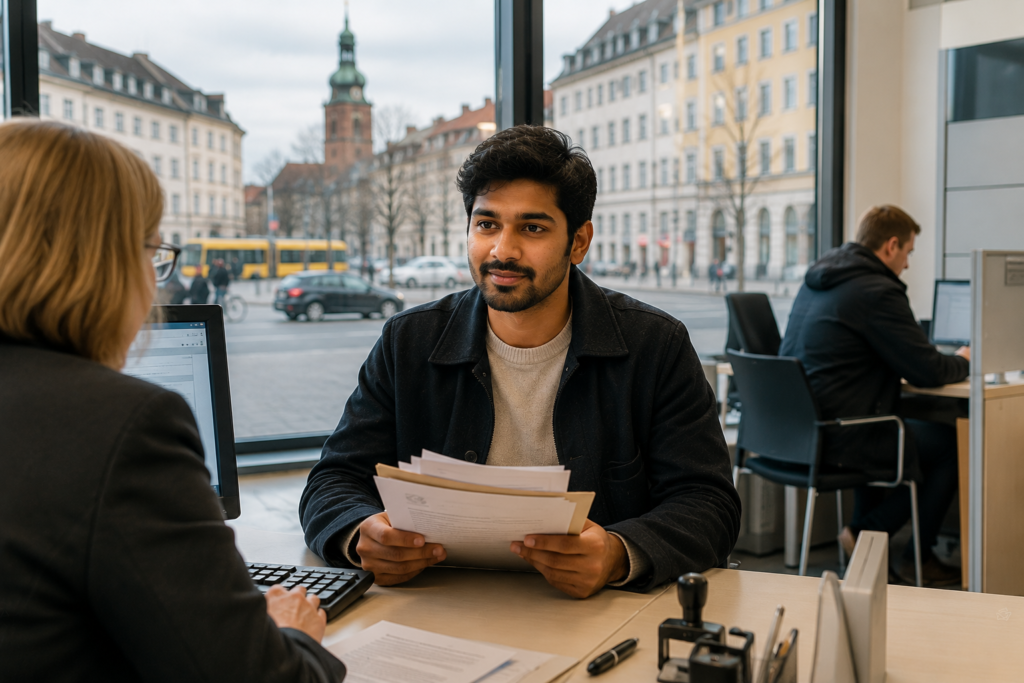
The application for a settlement permit is made at your local Ausländerbehörde — the foreigners authority. You can find the relevant office for your city through the BAMF navigator. The authority can also confirm exactly which documents you need for your particular situation.
Language certification at B1 or higher is typically demonstrated through a recognised test such as the Goethe-Institut B1 exam. Integration through daily life — living in Germany, working in German-language environments — counts, but a formal certificate is generally required.
The “Living in Germany” knowledge test covers basic questions about German law, society, and civil life. It is not difficult for someone who has spent a few years in the country, but it does require preparation.
The Bigger Picture
Germany did something significant with the 2023–2024 immigration reforms. It made a deliberate, policy-level decision to become more accessible to skilled workers from outside the EU — not just on paper, but structurally, by reducing waiting periods, adding new pathways, and streamlining the process.
The result, in the first year, was more than 200,000 employment visas issued. That number has continued to grow.
For Indians — and particularly for Malayalees who are already part of substantial Indian communities in cities like Berlin, Frankfurt, Munich, and Stuttgart — the opportunity is real. But it rewards preparation: understanding which pathway you are actually eligible for, meeting the language requirement proactively, and not relying on secondhand information to navigate a system that is detailed enough to matter.
Germany is not making this easy in the sense of removing all requirements. It is making it clearer and faster for those who genuinely qualify.
That distinction is worth understanding clearly before making decisions based on it.