Germany’s Chancenkarte: What Qualified Indians Should Actually Understand Before Applying
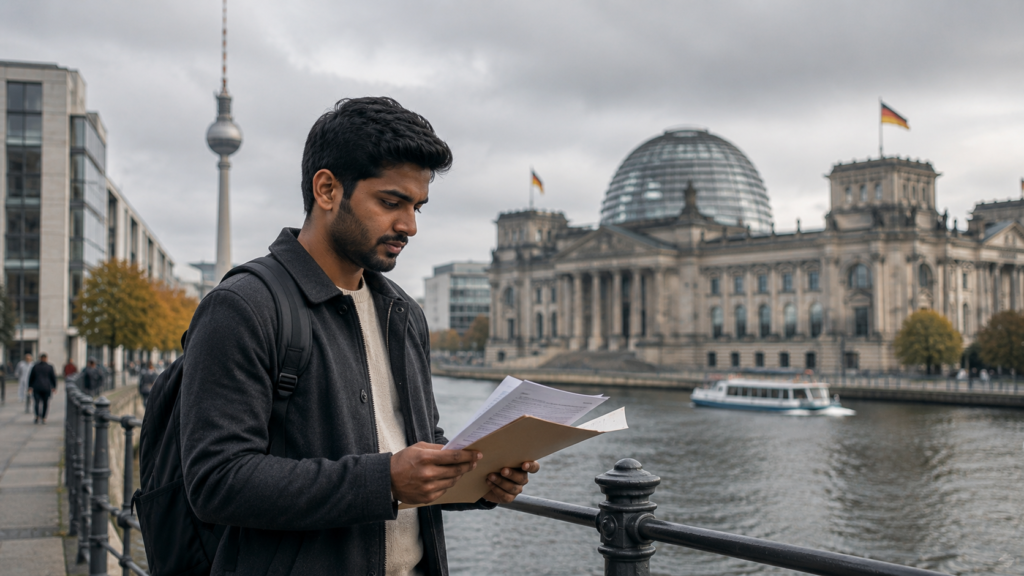
Germany introduced something genuinely unusual in June 2024: a visa that lets qualified professionals from outside the EU enter the country and look for work — without a job offer in hand. They called it the Chancenkarte, which translates loosely as the Opportunity Card.
For Indians seriously considering Germany as a career destination, this is worth paying close attention to. But it is not the shortcut it is sometimes described as in online forums and WhatsApp groups. Understanding the precise eligibility criteria, the financial reality, and what 12 months of job searching in a foreign country actually involves — that is what separates a well-informed decision from an expensive mistake.
What the Chancenkarte Actually Is
Before June 2024, a skilled worker from India who wanted to work in Germany typically had two options: find an employer willing to sponsor them before they arrived, or qualify as a recognised skilled worker under Germany’s existing immigration laws. Both routes had real friction.
The Chancenkarte, introduced under Section 20a of Germany’s Residence Act (Aufenthaltsgesetz) as part of the third phase of the country’s expanded Skilled Immigration Act, creates a new category. It is a national visa — not a work permit — that allows non-EU nationals to enter Germany for up to 12 months to search for employment locally. The German government officially directs applicants to the Make it in Germany portal for in-depth information, which is maintained by the Federal Ministry of Labour.
The logic behind it is straightforward: Germany has a significant and documented shortage of skilled workers across many sectors, and finding talent from abroad becomes easier when the talent is already in the country, meeting employers face to face.
The Eligibility Rules — Explained Simply
There are two ways to qualify for the Chancenkarte. Understanding which route applies to you matters, because they have very different requirements.
Route One: Direct Recognition
If your Indian degree or vocational qualification is already formally recognised as equivalent under German law, you qualify automatically without needing any points — provided you can show sufficient funds to support yourself. This applies to people who have already gone through the official recognition process through bodies like ANABIN or received a Statement of Comparability from the ZAB (Zentralstelle für ausländisches Bildungswesen, the German body for evaluating foreign qualifications).
Route Two: The Points System
Most Indians applying for the first time will take this route. If your qualification has not been fully recognised in Germany yet, you need to score at least six points from a defined set of criteria.
According to the Make it in Germany portal, the criteria and their approximate point values are:
- Partial recognition of your qualification (you’ve applied for recognition and received a partial equivalence result): 4 points
- Professional experience: 2 points for at least two years in your field in the last five years; 3 points for at least five years in the last seven
- Age: 2 points if you are 35 or younger; 1 point if you are between 35 and 40
- German language above A1: 1 point for A2, 2 for B1, 3 for B2; an additional point for English at C1 level
- Shortage occupation: 1 point if your field is listed as a shortage profession
- Previous stay in Germany: 1 point for at least six continuous months in the last five years
- Partner with Chancenkarte eligibility: 1 point
A few combinations are common for Indian applicants. A 28-year-old engineer with 3 years of post-graduation work experience, a B1 German language certificate, and a partial recognition result would already be near or above 6 points. Someone without any German language skills and limited work experience may find reaching that threshold harder.
One mandatory baseline applies regardless of route: you must demonstrate either German language skills at level A1 (very basic) or English proficiency at level B2. The A1 bar for German is quite low — enough to understand simple everyday sentences — but it still needs to be documented through a recognised test certificate.
The Financial Reality
This is where many applicants — and their families — need to think carefully.
To receive the Chancenkarte, you must demonstrate that you can support yourself financially in Germany for the duration of your stay. The most common way to do this is by opening a German Sperrkonto — a blocked account — before you arrive. Since 1 January 2025, the required amount is €13,092 per year, which works out to €1,091 per month, as stated on the official chancenkarte.com resource maintained for applicants and employers.
At current exchange rates of approximately ₹105 per euro, that works out to roughly ₹13.7 lakh that needs to be set aside in a blocked account. The account releases €1,091 per month to you once you are in Germany — it cannot be accessed all at once. This is a legal requirement, not optional.
For families in Kerala who are used to evaluating education expenses in terms of total cost — similar to the lakhs spent on MBBS admissions, professional coaching, or international study programmes — this figure is meaningful but not unfamiliar territory. What is different from a typical education abroad cost is that this money is not a fee or tuition; it is your living allowance, returned to you monthly. It is money that remains yours.
However, the total financial commitment is larger than just the blocked account. Factor in visa application fees, travel costs, health insurance (mandatory), accommodation deposits in Germany, and the practical expenses of relocating — and the picture becomes more complete.
What You Can Do During the 12 Months
The Chancenkarte is a job search visa, not a work permit. But it does allow you to work while you search, within defined limits:
- Part-time employment: up to 20 hours per week. At Germany’s minimum wage of €12.82 per hour (as of 2025), that can generate over €1,000 per month — enough to supplement your blocked account withdrawals.
- Trial employment (Probearbeit): unlimited two-week trial stints, which is a genuinely useful mechanism. It allows an employer to assess you before committing, and allows you to assess them.
If you find a full-time position during the 12 months, you can apply to change your residence title from the Chancenkarte to a regular skilled worker residence permit at the local Foreigners’ Registration Office (Ausländerbehörde). The process for that conversion is designed to be relatively smooth.
If the 12 months pass without a suitable position, the Chancenkarte cannot generally be extended under the same status. You would need to leave Germany.
Germany’s Labour Market Context
The Chancenkarte exists because Germany has a documented need for skilled workers that its domestic labour force cannot fill. According to the Federal Employment Agency’s May 2025 analysis, 163 of approximately 1,200 assessed occupations currently face critical shortages — meaning roughly one in eight skilled job categories struggles to fill vacancies.
The sectors with the most severe shortages include healthcare and nursing, the construction industry, skilled trades, logistics, and early-years education. This list matters for Chancenkarte applicants because being in a shortage occupation earns you an additional point in the assessment — and, more practically, gives you a better chance of finding work within 12 months.
The broader context: Germany’s Institute for Employment Research estimates the country needs approximately 300,000 skilled workers annually just to maintain current staffing levels. The Chancenkarte is one of several policy responses to that structural gap.
Indians Are Already Using It — In Large Numbers
Early data from the first months of the Chancenkarte’s operation is telling. According to reporting by Y-Axis, around 2,500 Opportunity Cards were issued between June and October 2024, with Indians accounting for approximately 780 of those — roughly 31% of all cards issued. Indians ranked first among all nationalities receiving the Chancenkarte in that period.
This reflects something that has been building for years: Germany has become an increasingly important destination for qualified Indians, particularly in engineering, healthcare, and information technology. Kerala’s professional class — nurses, engineers, and IT graduates in particular — has long been oriented toward the Gulf and the United Kingdom; Germany represents a newer but growing direction, particularly given the country’s structured pathways from initial entry to permanent residency.
What Families Should Weigh Before Deciding
For Malayalee students and young professionals weighing this option — and for the parents and extended family members who are often central to these decisions — a few things are worth discussing honestly.
The Chancenkarte is not a guaranteed path. You arrive in Germany, you search for work, and the outcome depends on your field, your German language level, your ability to network and interview, and the availability of relevant openings in the city or region you choose to settle in. Cities like Munich, Frankfurt, Berlin, and Hamburg have larger English-speaking professional ecosystems; smaller cities may require more German.
German language ability matters more than the A1 minimum requirement suggests. While the visa threshold is low, employers in most sectors — outside of certain IT and technology roles — strongly prefer candidates who can communicate professionally in German. Investing in language preparation before departure is not just advisable; it is practically necessary for most job seekers.
The €13.7 lakh in blocked account funds is real money. For households that are considering financing this through loans or liquidating savings, the calculation should account for the full 12-month period plus additional costs. A well-prepared arrival — with language skills, a realistic assessment of your field’s demand in Germany, and ideally some professional contacts — dramatically improves the likelihood of a positive outcome.
Applying from India
Indian applicants apply through the German Embassy in New Delhi or the German Consulates in Mumbai, Chennai, Kolkata, or Bengaluru, as confirmed by the German Missions in India. As of 2025–2026, applications can also be initiated through the Consular Services Portal at digital.diplo.de.
Processing times for Indian nationals typically range from 8 to 14 weeks from the date of application, with the new digital pre-check system reportedly reducing timelines compared to earlier paper-based processes. Given consulate workloads and document verification requirements — including degree validation — early and complete applications are significantly more likely to be processed without delays.
The Opportunity Is Real. So Is the Preparation Required.
Germany’s Chancenkarte represents a genuine opening. For a qualified Indian professional — someone with a relevant degree, some years of work experience, and ideally some German language ability — the ability to enter Europe’s largest economy and look for work without a prior job offer is a meaningful shift in how migration to Germany can happen.
But framing it as an “easy” route misses the point. The 12 months will be productive only for those who have done the homework: verified their points eligibility, secured the financial requirements, built language proficiency, researched their target industry and city, and understood what a German job search actually involves.
Used well, the Chancenkarte can be the first step in building a career and life in Germany. Used casually or impulsively, it can be an expensive year without the intended outcome.