
English Programmes in Germany — Not Quite What You’d Expect
Germany has quietly become one of the world’s largest destinations for English-medium postgraduate education. Nearly 1,930 master’s programmes are now taught entirely in English at German universities — more than any other non-English-speaking country in the world. For students from Kerala and across India, this has made Germany feel more accessible than ever. No German language requirement to get in. Familiar academic formats. Global-sounding programme names.
But there is a gap between what the brochure says and what the experience actually is. The academic culture, the composition of your peer group, and — most importantly — your career networking possibilities after graduation look meaningfully different depending on whether you study in English or in German. Most Indian students don’t get this picture clearly before they arrive. This article aims to fill that gap.
Why English Programmes in Germany Took Off
The growth in English-medium programmes in Germany was deliberate. German universities recognised that to attract international talent, they needed to offer programmes that didn’t require years of language preparation. DAAD (German Academic Exchange Service) data confirms Germany now hosts approximately 1,930 English-taught master’s programmes, making it the leading non-English-speaking destination globally for this type of education.
The results have been striking. India is now the largest source of international students in Germany, surpassing China for the first time. According to the DAAD’s 2025 India Country Report, 59,419 Indian students were enrolled at German universities in the winter semester 2024/25 — a 20% increase year-on-year, and more than double the number from five years ago.
Most of these students are in English-taught programmes. Most are in engineering, computer science, data science, and management disciplines. And most are making decisions based on what they found online: tuition is low or zero at public universities, the country has a strong job market, and the language of instruction is English.
All of that is true. But the complete picture requires a bit more nuance.
What the Classroom Actually Looks Like
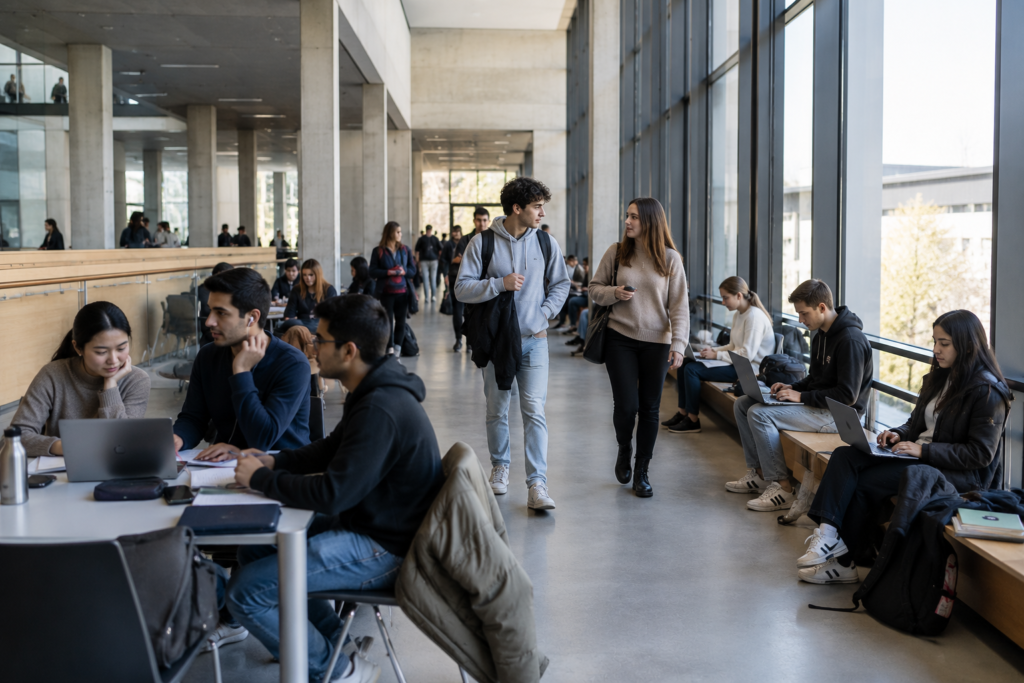
When you enrol in an English-taught master’s programme in Germany, the majority of your classmates will be international students — not Germans. This is structural, not coincidental. German students who are comfortable with their own language typically choose German-medium programmes. English programmes, by design, serve the international intake.
In practical terms, this means your classroom might be predominantly Indian, with peers from Southeast Asia, the Middle East, and Africa. Some programmes at major technical universities have cohorts where Indian students make up a substantial proportion of the class. This is not a criticism — it simply means the “immersion in a new culture and new way of thinking” that many students expect does not automatically come from sitting in lectures. It has to be actively sought outside the classroom.
This matters for more reasons than cultural enrichment. Peer networks formed during a master’s degree often shape careers. The industry referrals, the startup ideas, the job tips — these frequently move through people you studied alongside. If your network is primarily other international students without established connections in the German job market, that is a real practical constraint.
German students studying in German-medium programmes are, in parallel, building relationships with professors, research groups, and companies that operate entirely in German. Those pathways are less visible from the outside.
The Academic Culture Difference
German university culture is meaningfully different from what most Indian students experience at home — and this is true whether you study in English or German. German universities operate on a model of significant academic independence. Professors expect students to direct their own learning. Attendance is often not tracked. There are fewer assignments and more weight on a single semester-end examination or thesis. Office hours exist, but professors are not in the habit of chasing students.
For students coming from systems where regular feedback, structured coursework, and mentor relationships are the norm, this can be disorienting. Many Indian students describe the first semester as a period of adjustment — not because the material is harder, but because the expectation of self-direction is unfamiliar.
In German-medium programmes, this culture comes alongside the shared language that connects you to your professors and peers. In English programmes, the culture is the same but you are navigating it without that linguistic anchor to the broader university community.
Neither path is harder than the other, but they are different in ways that are worth understanding before you arrive.
The Career Reality: Language Matters More Than the Degree Language
Here is the part that surprises most students.
Your degree will be in English. Your thesis will be in English. Your transcript will be recognised globally. But when you look for a job in Germany after graduating, the German job market has its own requirements.
Research consistently shows that German language skills at B2 level or above correlate with meaningfully better employment outcomes. Approximately 70–80% of German job listings require B2-level German or higher, even in technical fields. Graduates with strong German language proficiency earn on average 15–20% more in their first job than peers with only English.
The sectors where English is sufficient tend to be specific: software engineering roles at multinational companies, research positions at international institutions, and some roles in global consulting firms. But for the broader German job market — including mid-sized German companies (the Mittelstand, as they are known, the backbone of the German economy), engineering firms, operations roles, and anything involving client contact — German is effectively a prerequisite.
This does not mean English-programme students are stuck. It means they need to be realistic and proactive. Germany’s 18-month job-seeker residence permit allows graduates from German universities to remain in the country while seeking employment — regardless of the language their degree was taught in. That is a valuable advantage. But the 18 months will be more productive if accompanied by at least conversational German, ideally B1 or B2.
For context on costs: the German government currently requires international students to maintain a blocked account (Sperrkonto) — a bank account reserved for living expenses — of €11,904 per year as of 2026. At today’s exchange rate of approximately ₹111 per euro, that is roughly ₹13.2 lakh held in reserve before you even arrive. This doesn’t include flights, application fees, or the semester contribution (Semesterbeitrag) — the administrative fee of roughly €150 to €350 per semester that covers health insurance, public transport, and university services.
For families in Kerala who have carefully planned for a child’s education abroad, this is a significant commitment. That commitment deserves a clear-eyed understanding of what the programme will and won’t deliver on its own.
What This Means for Indian Students Specifically
India’s presence in Germany’s universities is now substantial. At 59,419 students in the 2024/25 winter semester, Indians have overtaken every other nationality. Malayalees are well represented in this group — Germany has been a destination of serious interest for Kerala families, particularly for engineering and computer science master’s degrees.
This scale creates its own dynamics. Some English-taught programmes in Germany, particularly in computer science and electronics, now have very high concentrations of Indian students. This has led to the emergence of tight-knit Indian student communities in cities like Munich, Berlin, Stuttgart, and Aachen — which offer a sense of belonging, shared food and language, and mutual support that many students value deeply.
But it also creates a risk that some students recognise only in retrospect: it is possible to spend two years in Germany, study in English, live with Indian flatmates, socialise primarily with other Indians, and graduate with a strong degree — but without the local language, the local professional network, or the deep cultural exposure that many families imagine when they invest in an international education.
This is not a failure on the part of the student or the university. It is simply the natural result of choosing a path without fully understanding its shape. The students who tend to do best in Germany’s English-medium programmes are those who understand this dynamic going in, and who deliberately invest in learning German alongside their technical studies.
The Strategic Picture
Choosing an English-taught programme in Germany is a sound decision for many students. The universities are strong, the degree is internationally recognised, public university tuition is negligible, and the post-study work pathway is real and functional. There is nothing wrong with the choice.
The important thing to understand is that the English programme gets you in the door. What you do with the time on the other side of that door determines the career outcome.
Students who arrive with some German already — even A2 or B1 — and who commit to reaching B2 by the end of their degree consistently report better internship placements, better job search results, and a more integrated experience overall. Language learning in Germany is practical rather than academic: use it at the supermarket, at the university administration desk (Studentensekretariat), in casual conversations at campus events, and in part-time jobs (Werkstudent positions — student employment, typically up to 20 hours per week during the semester).
The German system rewards this kind of engagement. It does not reward passive attendance.
For families trying to understand the return on the investment, the honest answer is: a German university degree opens significant doors. But the student who leaves Germany fluent in German and with a local professional network has built something qualitatively different from the student who completes the degree in an English bubble and returns to India. Both paths are valid — but they are different, and worth choosing consciously.
Conclusion
Germany’s English-medium programmes are a genuine opportunity. The universities are credible, the fees are low, the legal pathway for post-study work is in place, and the Indian student community provides real on-the-ground support. None of that is fiction.
But the experience is different from studying in a native English-speaking country, and it is different from the picture many students and families form at the beginning. The classroom will be international, not German. The academic culture will be more independent than most students expect. The career market will reward German language skills in ways the brochure doesn’t emphasise.
The students who come to Germany with their eyes open — who know what the programme will and won’t hand them automatically, and who invest in the language and the local network — tend to build something lasting. That kind of clarity, before the decision is made, is what this piece is trying to offer.