
Germany’s Opportunity Card — Is It Actually Working for Indians?
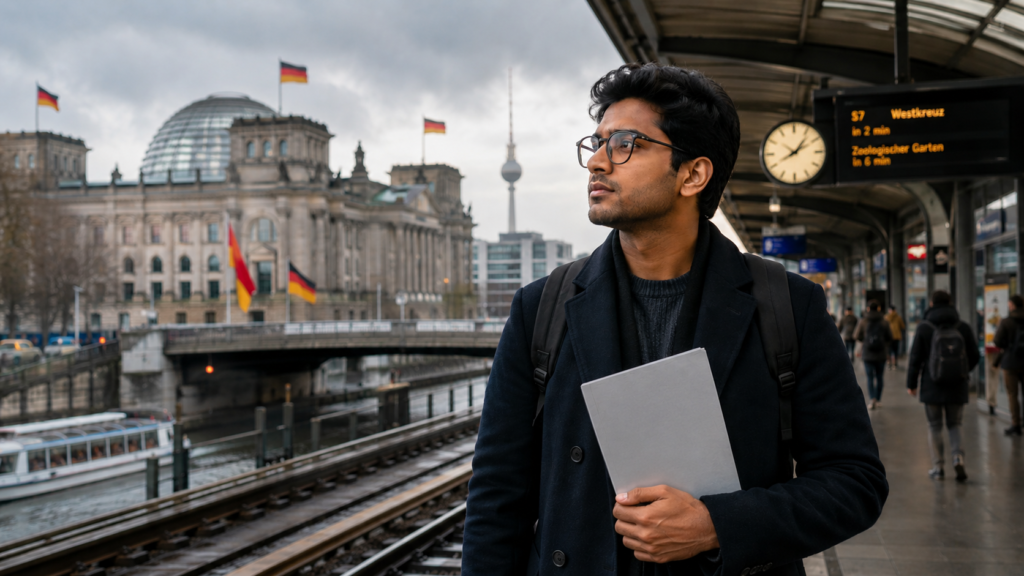
When Germany introduced the Chancenkarte — its Opportunity Card — in June 2024, it generated significant excitement among Indian professionals and graduates. Here was a country officially inviting skilled workers to come, look for a job, and settle in — without needing a confirmed offer beforehand. For many families in Kerala watching their children prepare to go abroad, this felt like a genuine opening.
Nearly two years on, the data exists. The question worth asking now is a practical one: is the Chancenkarte actually working for Indian applicants — and what does that data tell someone considering this route?
What the Opportunity Card Actually Is
The Chancenkarte (which simply means “Chance Card” in German) was introduced as the final phase of Germany’s Skilled Immigration Act, known in German as the Fachkräfteeinwanderungsgesetz. It came into effect on 1 June 2024, replacing the older job-seeker visa with a broader, more accessible system.
The core idea is this: a skilled professional from outside the EU can come to Germany for up to one year with the explicit purpose of finding qualified employment — without needing a job offer to start the process. While in Germany on the card, a holder can work up to 20 hours per week in any job (without needing the Federal Employment Agency’s prior approval). If they secure a full-time skilled role, they can convert the card into a full residence permit without leaving Germany.
There are two routes to qualify, as explained on Make it in Germany — the German government’s official skilled immigration portal:
Route 1 — The Qualification Route: If your foreign degree is formally recognised as equivalent to a German qualification (verified through the German database called Anabin, or through an official Statement of Comparability from the ZAB, the German authority for educational equivalence), you qualify directly.
Route 2 — The Points Route: If your degree doesn’t have direct recognition, you can still qualify by scoring a minimum of six points across five criteria: partial recognition of your qualification (4 points), professional experience (2–3 points), German or English language skills (1–3 points), age below 40 (1–2 points), and a previous stay in Germany (1 point).
Both routes require proof of sufficient funds — as of 2025, this means demonstrating at least €1,091 per month, or approximately ₹1,22,200 per month at current exchange rates (around ₹112 per euro). For a full year, that means showing access to roughly €13,092 — about ₹14.7 lakh — in a blocked account or similar financial proof.
The Numbers: Who Has Actually Got In?
This is where things get genuinely interesting. According to a November 2025 report by the German Economic Institute (IW Köln), a total of 11,497 Opportunity Card visas were issued by German diplomatic missions worldwide in the first year of the scheme (from 1 June 2024 to 15 June 2025).
India accounted for nearly one-third of all visas issued — 3,721 Opportunity Cards granted to Indian nationals in that period. China came in a distant second, with 807. Other source countries include Turkey, the United Kingdom, Tunisia, and Egypt. By November 2025, that global total had grown to 17,489, according to reporting from VisaHQ.
India, in short, is not just participating in this scheme — it is the dominant source country by a large margin.
But here is the nuance that matters. The German government had originally expected around 30,000 Chancenkarte visas to be issued annually. The actual number after 18 months is significantly below that projection. The Green Party, and various policy observers, have described the programme as underperforming relative to its potential. The demand is clearly there — nearly 500,000 visits to the Make it in Germany portal’s Opportunity Card pages in 2025 alone — but the pathway from interest to visa has proven rougher than anticipated.
Why Applications Are Being Rejected or Delayed
The IW Köln report identifies several structural problems that are affecting applicants — and the German Consulate in Mumbai’s own official guidance adds further clarity on what Indian applicants should anticipate.
The Anabin problem is the most significant. Many Indian universities and degrees are either not listed in the Anabin database, or are listed with a classification that doesn’t automatically confirm equivalence. If your institution is not verified in Anabin, you must apply for a Statement of Comparability (Zeugnisbewertung) from the ZAB. This takes additional time and money — and many applicants either don’t know this, or underestimate the processing time before their visa appointment.
Inconsistent processing times are a genuine issue. The IW report confirms that waiting times at different German consulates vary considerably. Some consulates process applications within a few weeks; others have reported multi-month delays. For India, which generates high application volumes across consulates in New Delhi, Mumbai, Chennai, and Bengaluru, the queue can be substantial. Most Indian applicants should realistically plan for four to six months between appointment and a visa decision.
Language certificate validity is another point where applications stumble. English certificates (for B2 level) and German certificates (for A1 level via the points route) must have been issued within the past two years. An older certificate — even a legitimate one — will not be accepted.
Employer awareness in Germany remains low. The IW report makes an uncomfortable but important point: many German employers still don’t know what the Opportunity Card is, or what it permits a holder to do. This creates a practical challenge even after arrival. A holder who arrives in Germany with the card still needs to navigate a job market where potential employers may be unfamiliar with the legal framework, including the fact that an Opportunity Card holder can work 20 hours per week immediately without needing separate work authorisation.
What This Means for Indian Professionals — and Especially Those from Kerala
India’s dominance in Chancenkarte applications reflects something real about the Indian workforce: a large, English-speaking, technically qualified pool of graduates in exactly the sectors Germany is trying to fill. According to the Federal Employment Agency, there are currently more than 617,000 unfilled positions across Germany, spanning 163+ officially classified shortage occupations. IT, engineering, healthcare, construction, and logistics feature prominently.
For Malayalee graduates — many of whom hold engineering, nursing, or IT degrees — this is a structural alignment worth noting. The sectors Germany needs workers in are precisely the sectors Kerala has historically produced graduates for. Nursing and healthcare professionals from Kerala have been finding work in Germany through other routes for several years; the Chancenkarte creates an additional path, especially for IT and engineering graduates who may not yet have a job offer in hand.
The financial threshold — approximately ₹14.7 lakh in demonstrable funds for a year — is significant. For families planning to support a graduate’s move abroad, this is comparable to a year’s tuition at a private engineering college in Kerala. It is a real commitment, but not an unusual one for families who have already navigated similar decisions.
What is different here compared to a student visa is the stakes of the intermediate period. A student in Germany has a university structure around them: orientation, classmates, a campus. An Opportunity Card holder arrives as a professional job-seeker. The settling-in period requires personal initiative, networking, and often some German language ability — even though the card itself does not require full German proficiency if you qualify through the points route using English.
The Strategic Picture: Is It Worth It?
The honest answer is: it depends on your profile, and on whether you go in with accurate expectations.
For Indian applicants who have a degree in a shortage field, verifiable professional experience, and either German language skills or strong English (B2+), the Chancenkarte is a genuine opportunity. India’s 3,721 approvals in the first year are not a small number — they represent real people who are now in Germany, looking for work, and many of whom will secure skilled employment and transition to longer-term residence.
The challenge lies in the gap between expectation and reality. The scheme was marketed as a streamlined route; in practice, the paperwork involved in degree recognition, blocked account setup, health insurance verification, and motivation letter requirements means it rewards preparation far more than it rewards enthusiasm. Applicants who have properly researched Anabin status, sorted their ZAB statement in advance, and have a realistic sense of the German job market in their sector tend to fare significantly better.
The German government’s own data, cited in the IW report, confirms that there is no current mechanism to track how many Opportunity Card holders actually find employment after arriving. That gap — between visa issuance and employment outcome — is where the scheme’s real story is still being written.
What Prospective Applicants Should Understand
A few honest, practical points that the data supports:
Check Anabin first, before anything else. Your institution’s status in the Anabin database will determine whether you qualify via the skilled worker route or the points route, and whether you need a ZAB statement. This step shapes everything that follows.
The financial proof is non-negotiable. Approximately ₹14.7 lakh in accessible funds, usually held in a blocked account (a Sperrkonto, a German term for a restricted savings account specifically designed for this purpose), must be demonstrated at the time of application. This is a real cost of entry, not a formality.
Processing time is not in your control, but preparation is. Applications from India face high volume. Build in a minimum of six months between your application appointment and your intended travel date.
The card is an opportunity, not a guarantee. Arriving in Germany with an Opportunity Card is the start of a process, not the conclusion of one. The job market rewards German language ability, professional networking, and an accurate understanding of how German hiring works — which is quite different from job searching in India or the Gulf.
Conclusion
Germany’s Opportunity Card is real, it is being used, and India is its largest beneficiary by a significant margin. The programme has genuine potential for qualified professionals — and the structural need in Germany’s economy is not in question. Over 600,000 unfilled positions do not lie.
But the gap between ambition and performance — 17,489 visas issued against a 30,000 annual target — reflects genuine friction in the system: documentation complexity, inconsistent consulate processing, and an employer awareness problem inside Germany. These are real hurdles that well-prepared applicants can navigate, and unprepared applicants often don’t.
The Chancenkarte is not a shortcut. It is a structured pathway for professionals who are ready to invest time, money, and effort into the process. For those who are — and particularly those whose qualifications map to Germany’s most critical shortage sectors — it remains one of the more accessible legal routes into the German job market that currently exists.